
The Westside Turnover Rent Bump Is Gone: What a Year of Our Own Lease Data Shows (Fall 2026)
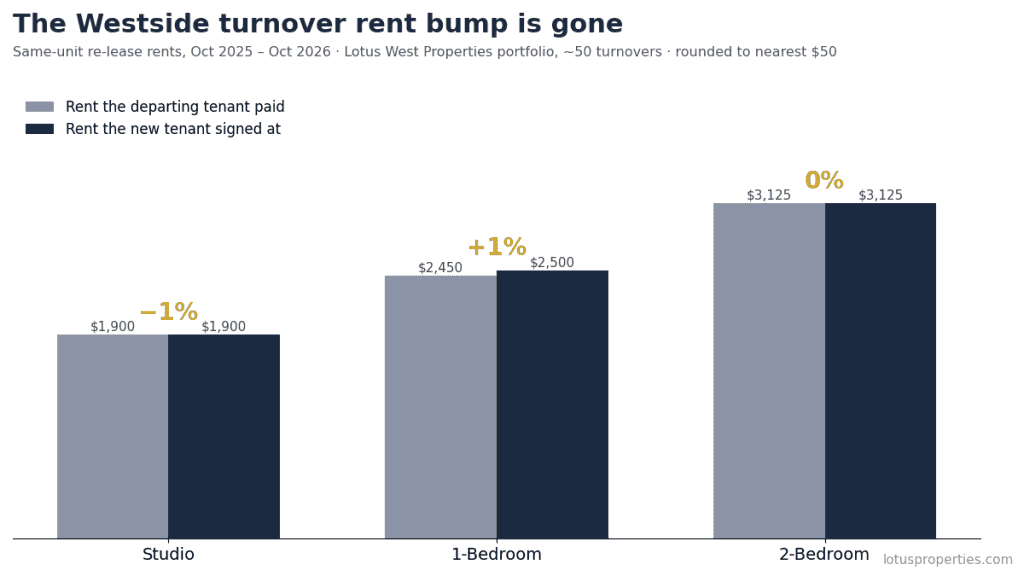
Quick summary: For twenty years, a vacancy on the Westside came with a consolation prize: you re-leased the unit at a higher rent. Our own portfolio data says that prize has disappeared. Across roughly fifty same-unit turnovers in the twelve months to October 2026, the new tenant signed at almost exactly what the departing tenant was paying — within about one percent, up or down, for studios, one-bedrooms and two-bedrooms alike. Vacancy is now a pure cost. Here is what we measured, why we think it is happening, and what to do about it before your next move-out.
What we measured, and why it is different from a rent report
Most “rent is up X%” headlines compare the average asking rent this month with the average a year ago. That mixes new buildings with old, big units with small, and listings with signed leases. It tells an owner nothing about the one question that matters when a tenant gives notice: if this exact unit turns over, what will the next person actually pay?
So we asked that question of our own buildings. Lotus West manages roughly a thousand apartments across the Westside — Brentwood, Santa Monica, West LA, Mar Vista, Hollywood, Koreatown and Mid-City. For every unit where a tenant moved out and a new tenant moved in over the past year, we compared the rent on the new lease with the rent the previous tenant was paying on the same unit. No asking rents, no listings, no other people’s buildings. Signed leases only.
The result: a flat line
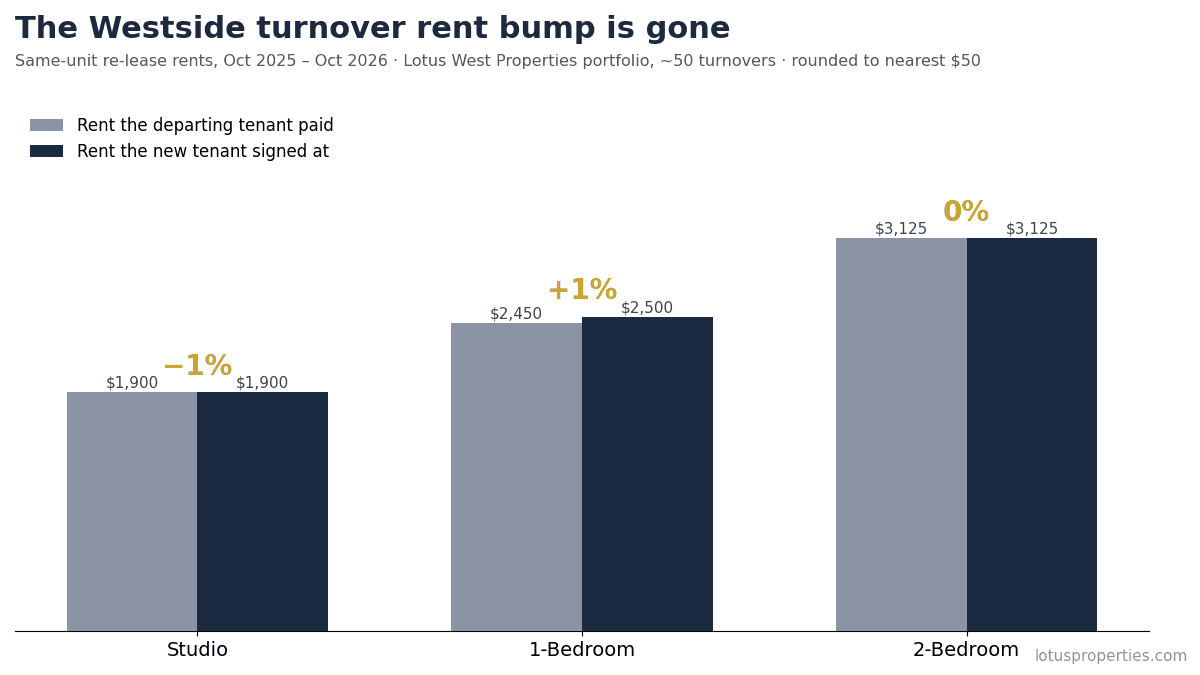
| Unit type | Departing tenant paid (avg) | New tenant signed at (avg) | Change on turnover |
|---|---|---|---|
| Studio | about $1,900 | about $1,900 | roughly −1% |
| 1-bedroom | about $2,450 | about $2,500 | roughly +1% |
| 2-bedroom | about $3,125 | about $3,125 | flat |
Put plainly: the tenant who left in 2026 was already paying market rent. Whoever replaced them paid the same. The last ninety days, which cover the late-summer leasing season that usually produces the year’s biggest resets, show no bump either.
For most of the past decade a Westside move-out was, in effect, a rent increase you did not have to serve notice for: the departing tenant’s rent lagged the market, and the new lease closed the gap. That era is over, at least for now.
Why the turnover bump disappeared
- In-place rents caught up. Three years of annual increases at the AB 1482 and RSO caps closed most of the gap between what long-term tenants pay and what the market charges. When the gap is gone, there is nothing for a turnover to “unlock.”
- Asking rents have stalled. Westside asking rents have moved sideways this year, and move-in concessions have reappeared in newer buildings. A vacated 1990s unit now competes with a 2024 unit offering weeks free.
- The displacement wave normalized. Early 2025 brought a surge of fire-displaced households that absorbed Westside inventory in weeks and pushed rents up. Most of those households have now settled, rebuilt, or moved on, and the market has given that premium back.
- Tenants are shopping harder. In our own leasing this year we see more applicants negotiating, more leases signed after a price adjustment, and longer days to lease on any unit priced above the building’s own comparables.
What this changes for owners
If turnover no longer raises rent, then every day of vacancy is money you will not get back. A $2,500 one-bedroom that sits empty for six weeks costs about $3,500 in lost rent before you count turnover repairs, painting, cleaning and marketing — typically another $1,500 to $3,000 on a Westside unit. Compare that with the alternative, which is often a tenant who would have stayed for a modest increase or a small repair.
| Weeks vacant | Lost rent on a $2,500 unit | Plus typical turnover cost | Months of a 3% increase needed to recover it |
|---|---|---|---|
| 2 | $1,150 | $2,650 – $4,150 | 35 – 55 months |
| 4 | $2,300 | $3,800 – $5,300 | 50 – 70 months |
| 6 | $3,500 | $5,000 – $6,500 | 65 – 85 months |
Five things we are doing differently in our own buildings this fall, which any owner can copy:
- Treat the renewal like the lease-up it is. Call good tenants 90 days before expiry, not 30. A $50 increase accepted is worth more than a $200 increase that produces a move-out.
- Price a vacancy to lease in 14 days. Our rule of thumb this fall: a Westside unit that has not leased in two weeks is overpriced by $75 to $150. Cutting on day 15 beats holding out to day 45 every time.
- Spend the “turnover premium” on the unit instead. If the market will not pay more for the same unit, make it a better unit: in-unit laundry, a dishwasher, LED and hard-surface floors reliably move a one-bedroom up a tier. That is where the premium now lives.
- Use the in-place increase you are allowed. The 2026–27 caps are 8.7% for AB 1482 units in LA County, 3% for City of LA RSO units, and lower in Santa Monica, West Hollywood and Beverly Hills. In a flat market, the allowable in-place increase is often the only increase available. Serve it correctly and on time.
- Watch the expense side. With rents flat and FAIR Plan premiums up 29% on October 15, net operating income on an older Westside building is being squeezed from both ends. Insurance, water and trash are the three lines worth re-bidding this quarter.
A note for rent-stabilized owners
Under the City of LA’s RSO, a vacancy still lets you reset the unit to market. What our data says is that, for most units in 2026, “market” is roughly what the last tenant was paying. The strategy of waiting out a long-term tenant to capture a reset is producing very little this year. The owners doing best in our portfolio are the ones who kept their tenants, took the allowable increase, and put money into the building rather than into vacancy.
How we counted
We used resident move-in dates from our property management system, matched each move-in to the prior resident’s recorded rent on the same unit, and compared the two. Units without a recorded prior rent, non-revenue units and new construction were excluded. Figures above are rounded to the nearest $50 and percentages to the nearest point; the underlying counts are a few dozen turnovers per unit type over twelve months, which is a real sample of signed Westside leases but not a citywide statistic. We will re-run this in January and publish the update.
Want to know what your building would re-lease at, and what it costs to keep it full? We run a free building evaluation for Westside owners: current rents against our same-unit comparables, allowable increases for each unit, and the three expense lines most worth re-bidding. No obligation. Call (323) 487-2650 or request it online.

Byron Yamada has served as a property manager at Lotus West Properties for more than 22 years, making him one of the longest-tenured members of the team. Across more than two decades managing multifamily properties throughout the Greater Los Angeles area, he has built deep, hands-on expertise in day-to-day operations, tenant relations, and the city’s demanding rent-stabilization and compliance landscape. For the owners and residents he works with, that experience means a steady, knowledgeable point of contact who knows both the buildings and the rules that govern them.